Senegal’s Credit Story Changes Shape: What the debt treatment means for the sovereign’s ratings, creditors, and path back to market access

On the afternoon of 1 September 2026, Senegal’s finance ministry and the IMF released, within hours of each other, two statements that might look, on a first read, like they were pulling apart. The first announced that IMF staff and Senegalese authorities had reached agreement on the policies underpinning a new Extended Credit Facility arrangement worth about $2.2 billion, the country’s first prospective IMF programme since 2024. The second announced that Senegal would pursue a sovereign initiative debt treatment plan, the Plan de Traitement de la Dette du Sénégal, aimed at securing a treatment of Senegal’s debt obligations while explicitly protecting CFA-franc-denominated debt. They were not, on closer reading, competing signals. The IMF’s own statement references the debt treatment directly, describing it as part of the authorities’ effort to restore debt sustainability, the condition an IMF-supported programme needs before it can proceed (IMF, 2026). Read together, the two announcements describe a single coordinated strategy: a government whose access to affordable finance had narrowed so far that concessional support and a treatment of the debt stock had to arrive as one package, not as alternatives.
For anyone following Senegal’s sovereign credit position, the coincidence of these two announcements was not really a coincidence. It was the point at which two years of deteriorating fundamentals, two credit rating agencies’ worth of downgrades, and one government audit’s worth of misreported debt finally converged on a single mechanism. The question that had occupied the credit rating agencies since October 2024, whether Senegal could avoid a debt treatment altogether, has now been answered. The question that replaces it - what that treatment will look like, who bears its costs, and whether it will eventually be classified as a default - is harder, and it is the one this piece sets out to address. This is a piece about that transition: from a ratings problem centred on the probability of a debt treatment to one centred on its design and consequences.
The audit that rewrote the balance sheet
Senegal’s crisis has an origin date, though its full scale took over a year to establish. In September 2024, incoming Prime Minister Ousmane Sonko accused the outgoing government of Macky Sall of having misrepresented the country’s fiscal position to its partners. Moody’s acted within weeks, downgrading Senegal’s long-term ratings to B1 from Ba3 and opening a review for further downgrade on 4 October 2024, and the IMF suspended a $1.8 billion credit facility pending its own review of the revised data.
What the IMF and the credit rating agencies were reacting to in late 2024 was provisional. The definitive account came from Senegal’s own Cour des Comptes, whose Chambre des Affaires Budgétaires et Financières published its final audit of public finances for the 2019-to-March-2024 period in February 2025. The Cour’s central finding concerned the stock of central government debt at the end of 2023. Under the reporting basis used in the government’s own budget-settlement documents, outstanding central government debt stood at 74.41 per cent of GDP. Reconstructed by the Cour, using data obtained directly from Senegal’s Direction de la Dette Publique alongside its own investigative work, the same stock came to 18,558.91 billion CFA francs, equivalent to 99.67 per cent of GDP, a gap of just over twenty-five percentage points relative to the figure contained in the government’s reporting basis (Cour des Comptes, 2025). The IMF, separately, suspended its $1.8 billion credit facility over the underlying misreporting to the Fund itself, a distinct problem addressed further below. Reuters later characterised this as implying roughly $7 billion in previously unreported borrowing (CNBC Africa, 2026).
The gap was not confined to a single instrument or a single year. The Cour’s audit documented substantial borrowing, much of it contracted through the banking system, that had never passed through Senegal’s normal budgetary reporting circuit and so had never been reflected in the debt figures the government presented to creditors or to the IMF. None of this required a whistleblower or a leaked document but only that Senegal’s official reporting failed to capture obligations that already existed.
The consequence for creditworthiness assessment ran deeper than a growing debt burden. The reported figure had been shown, by the country’s own supreme audit institution, to be unreliable, and unreliable in one direction only. That distinction shaped everything that followed. A downgrade driven by rising debt is one an agency can model forward from a trusted base. A downgrade driven by discovering that reported debt data cannot be trusted forces an agency to reprice not the level of the risk but its own confidence in the inputs, and that is a harder problem to close. The IMF’s own suspension, described above, was itself a recognition of this: a fiscal anchor cannot be extended on numbers the anchor-provider no longer trusts.
From B1 to Caa2: how the reasoning changed
Between October 2024 and August 2026, Senegal’s sovereign ratings moved through nine documented actions across the two agencies, and the reasoning behind them shifted as much as the rating level did.
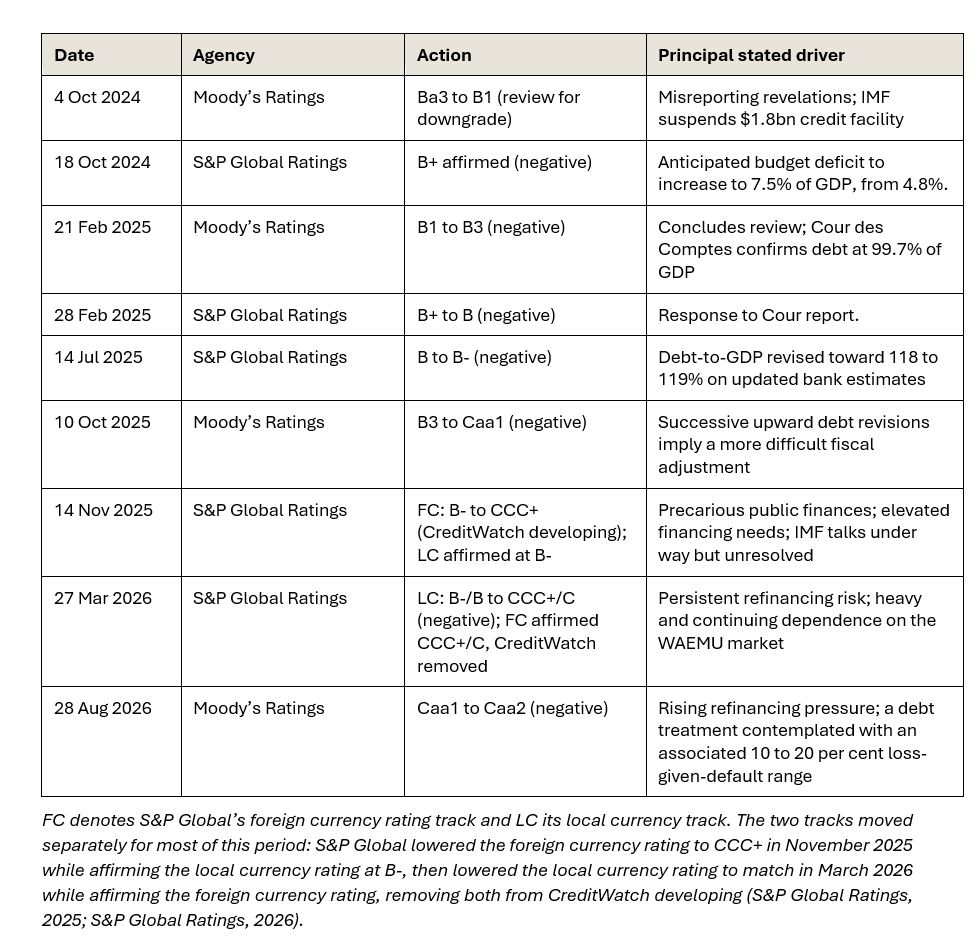
S&P Global moved first among the two agencies, revising its outlook on Senegal’s B+ rating to negative on 18 October 2024, then downgrading to B on 28 February 2025 and to B- on 14 July 2025, as bank estimates pushed debt toward 118 to 119 per cent of GDP (CNBC Africa, 2026). Moody’s downgraded to Caa1 from B3 on 10 October 2025, citing a further debt reconciliation that put the 2024 stock at 119 per cent of GDP, about twelve percentage points above its own February 2025 estimate, and slower-than-expected progress toward a new IMF programme, which left the government reliant on the costlier WAEMU market to help meet gross financing needs of around 26 per cent of GDP (Moody’s Ratings, 2025b). Moody’s baseline still assumed eventual IMF support on terms that would not require a restructuring, but it said its confidence in that outcome had diminished, and that the longer support was delayed, the higher the risk of a restructuring involving private-sector creditors became, the same logical structure the August 2026 Caa2 action would later make explicit with a specific loss-given-default figure attached. Moody’s own language on the WAEMU market was more balanced than a reading focused only on risk would suggest: the same release called Senegal’s WAEMU membership ‘an essential credit support’ that helps contain risks from the country’s high foreign-currency debt, while separately warning that rising dependence left the government more exposed to any reversal in regional investor sentiment or to strains in the market’s capacity to absorb further issuance (Moody’s Ratings, 2025b). S&P Global’s own March 2026 rationale strikes a similar balance: candid that regional financing carries shorter tenors and higher costs and that rising reliance on it heightens rollover risk, while also crediting the regional market’s continuing absorptive capacity and Senegal’s efforts to lengthen the maturity of its domestic issuance. Read against each agency’s own words, not secondary commentary on them, the difference between the two agencies is only slight.
The November 2025 and March 2026 S&P Global actions are where the story gets more technical, and more interesting for anyone tracking the mechanics, not just the headline. On 14 November 2025, S&P Global lowered only its foreign currency long-term rating, to CCC+ from B-, while affirming the local currency rating at B- and placing both on CreditWatch developing. The stated rationale centred on elevated 2026 gross financing needs, which S&P Global put at 26 per cent of GDP on its base case and closer to 29 per cent on a more conservative deficit forecast, against a debt stock estimated at 119 per cent of GDP, itself over 40 percentage points above what had originally been reported (S&P Global Ratings, 2025). Four months later, on 27 March 2026, the agency lowered the local currency rating to CCC+/C to match, affirmed the foreign currency rating at the same level, and removed both from CreditWatch, citing persistent refinancing risk and continuing dependence on the WAEMU market despite a lengthening of the average maturity on domestic issuance, from 1.8 years in 2024 to 2.3 years in 2025 (S&P Global Ratings, 2026). By March 2026, in other words, S&P Global’s foreign and local currency views of Senegal had converged on the same rating from different directions.
Readers comparing debt-to-GDP percentages across these sources should treat them as describing related but distinct measures, not one continuous series. The Cour des Comptes figure covers central government budgetary debt at end-2023 only. S&P Global’s 118 and 131 per cent figures are its own estimates for December 2025 on a wider, consolidated perimeter that adds state-owned enterprise liabilities and arrears (S&P Global Ratings, 2026). The Financial Times’ later reference to debt having swollen past 130 per cent of GDP in 2024, before falling back toward 100 per cent by 2026, reflects a combination of genuine fiscal consolidation and a rebasing of Senegal’s GDP series, not debt reduction on its own. This piece has not attempted to force these series into a single continuous figure.
That full sequence, four Moody’s actions and five S&P Global actions across twenty-two months, is now documented from both agencies’ own rating action commentaries and a consistent third-party ratings history. The most recent Moody’s action, the August 2026 downgrade to Caa2, is worth examining in detail, because it marks the point at which Senegal’s credit story stopped being principally about the probability of a debt treatment and started being about its shape.
A downgrade that already assumed the treatment
On 28 August 2026, Moody’s downgraded Senegal’s long-term issuer and senior unsecured ratings to Caa2 from Caa1 and maintained the negative outlook carried over from earlier in the cycle. The stated reasoning combined three familiar strands - rising refinancing pressure, weakening debt affordability, and growing reliance on regional markets over international ones (which observers have commented ought not to be such a credit negative [Mutize, 2025]) - but the release also did something the earlier actions reviewed here had not done as explicitly: it named a debt treatment involving private-sector creditors as one of two routes by which a default event could occur, the other being prolonged liquidity strain absent such a treatment (Moody’s Ratings, 2026).
The technical detail that gives this action its weight for anyone reading Senegal’s credit story is Moody’s loss-given-default framing. The rating committee judged Caa2 consistent with a debt treatment aimed primarily at easing liquidity pressure and involving limited losses for private-sector creditors, an outcome it associated with a loss-given-default range of 10 to 20 per cent (Moody’s Ratings, 2026). The negative outlook, in turn, reflected the risk that losses could prove materially higher than that range if IMF support, concessional financing access, and fiscal adjustment continued to be delayed, in which case Moody’s judged that restoring debt sustainability would ultimately require a broader restructuring.
It would overstate the case to describe this as Moody’s predicting the events of 1 September. What the 28 August action shows is something narrower and, for ratings purposes, more useful: a debt treatment involving private creditors had already moved from a remote possibility into the working assumption behind the assigned rating, with a specific loss magnitude attached to it, several days before Senegal’s government confirmed that such a treatment was in fact coming. The rating did not react to the announcement but rather anticipated the category of event the announcement then confirmed.
Two supporting figures from the same release are worth carrying forward. Interest payments had risen to 23.7 per cent of government revenue, from 16.1 per cent in 2023, a measure of debt affordability deteriorating faster than the headline debt ratio alone would suggest. Gross financing needs stood at around 25 per cent of rebased GDP for 2026, funded increasingly through regional issuance, equivalent to about 8 per cent of GDP raised on the WAEMU market since the start of the year alone, because access to international capital markets remained prohibitively expensive (Moody’s Ratings, 2026). Both figures describe the same underlying condition from different angles: a government still able to finance itself, but increasingly through channels that were shorter in tenor, higher in cost, and more exposed to any change in regional market appetite.
Two announcements, one afternoon
The IMF’s end-of-mission statement, issued by mission chief Mercedes Vera Martin after roughly two weeks of discussions in Dakar, describes a staff-level agreement on the policies that could underpin a 36-month Extended Credit Facility arrangement of about $2.2 billion, or 475 per cent of Senegal’s IMF quota. The wording is precise and worth preserving precisely: a staff-level agreement is not an approved programme. It requires the IMF’s Management and Executive Board to approve it, it requires decisive corrective action to support Senegal’s request for a waiver in the misreporting case, and it requires financing assurances from Senegal’s other partners before the Board will consider it (IMF, 2026). None of that is a formality in a case where the underlying offence was fiscal misreporting to the Fund itself; the waiver request exists precisely because Senegal breached its IMF reporting obligations, and the Fund’s own emphasis on further decisive action being critical to closing that chapter signals that this remains unfinished business, not a closed one (IMF, 2026).
Coverage in the financial press illustrates how easily the distinction gets lost outside specialist audiences. The Financial Times’ own headline described an agreed $2.2 billion bailout, even though its article body was more careful, describing a staff-level plan, not a disbursed facility (Financial Times, 2026). For anyone assessing the credit implications, the distinction is not pedantic. A completed IMF programme is a source of concessional financing and a fiscal anchor. A staff-level agreement is a credible signal of both, contingent on steps that have not yet happened.
The debt treatment plan announced by Senegal’s Ministry of Economy, Finance, and Planning on the same day carries no such conditionality, because it is, on its own description, a sovereign initiative designed and led by Senegalese authorities, not negotiated in advance with creditors. The ministry’s statement frames the PTDS as the next step in a debt management strategy under way since 2024, one that had already cut the fiscal deficit from 13.4 per cent of GDP in 2024 to 6.4 per cent in 2025, but that was overtaken in 2026 by a narrowing of fiscal space linked to the war in the Middle East, its effect on energy costs, and its drag on public and private investment. Growth for 2026 is now projected at 2.7 per cent, down from 6.7 per cent in 2025 (Ministry of Economy, Finance, and Planning, 2026).
Placed together, the two announcements are two parts of one design, not competing signals. The IMF statement addresses the flow problem, Senegal’s capacity to finance itself and adjust its budget going forward, and its own text treats the debt treatment as a condition of that programme, not a separate development, describing the authorities’ pursuit of a treatment as part of the effort to restore debt sustainability (IMF, 2026). The PTDS addresses the stock problem; the debt already outstanding on unsustainable terms. Ratings analysis has to hold both in view at once: a programme that eases the flow problem does not by itself resolve the stock problem, and a treatment that addresses the stock problem could, depending on its design, either reinforce or undercut the credibility the IMF relationship is meant to supply.
What is being protected, and from whom
The PTDS statement is explicit about what it will not touch: debt denominated in CFA francs is excluded from its scope, on the ground that the regional market plays too central a role in financing the Senegalese state and its economy to be disturbed (Ministry of Economy, Finance, and Planning, 2026). Beyond that exclusion, the government’s own statement is short on specifics. It commits to an enhanced version of the G20 Common Framework, offering a compressed implementation timeline, earlier information-sharing, and consultation with creditor groups run in parallel, not in sequence, but it does not yet specify which external instruments fall within scope, what losses different creditor classes might bear, or how the process will treat Senegal’s Eurobonds relative to its official and commercial external creditors.
The market’s own reaction supplies some of what the announcement withheld. Senegal’s euro-denominated bonds due 2028 fell by roughly seven cents to 49 cents on the euro immediately after the plan was announced, and dollar-denominated bonds fell by about two and a half cents to 49 cents on the dollar (Financial Times, 2026). A bond price near 49 is not a direct reading of expected haircut: it reflects timing, discount rates, the probability of alternative outcomes, the prospect of arrears along the way, and lost coupon income, not a single loss percentage. What the pricing does show is that the market remained severely distressed after the announcement, consistent with materially greater uncertainty about eventual recovery than a benign, liquidity-only reprofiling would imply. That sits uneasily beside Moody’s Caa2 scenario of 10-to-20-per-cent losses, though the two measures are not directly comparable. Moody’s figure describes a specific, limited scenario consistent with the assigned rating, while bond prices reflect the market’s own probability-weighted view across better and worse outcomes, including the tail risk the negative outlook was designed to flag.
A further complication concerns total return swaps. The Financial Times reported that Senegal borrowed at least €650 million during the previous year through swap arrangements collateralised by domestic bonds, on terms that were not shared with the IMF at the time they were struck, and that Senegal’s parliament authorised an investigation into this borrowing the month before the PTDS announcement (Financial Times, 2026). Bondholders, according to the same reporting, fear that Senegal will seek to exclude these swaps and their collateral from any restructuring because of their links to domestic debt held largely by local banks. If that fear is realised, it would extend the same logic behind the CFA franc carve-out to a second category of obligation, on broadly the same grounds: protecting instruments whose disruption would fall most heavily on the domestic financial system.
That logic produces a genuine analytical tension, not a merely rhetorical one. The instrument Senegal most wants to protect - its access to WAEMU regional financing - is the same instrument that S&P Global and Moody’s have separately identified as a source of vulnerability: shorter maturities, higher cost, and a debt structure that has grown more dependent on it precisely because international market access closed. Treating the domestic and regional market as effectively untouchable while restructuring external Eurobonds may protect financial stability at home in the near term, but it does not by itself reduce Senegal’s reliance on financing that both credit rating agencies have already flagged as costly and short-dated. A restructuring that shrinks the external debt stock while leaving that underlying reliance intact would only partially address the vulnerability the credit rating agencies have been describing since 2025.
The line between reprofiling and default
Whether the PTDS eventually triggers a formal default or distressed-exchange classification from Moody’s or S&P Global is, on the material available here, an open question, and it should be treated as one. Both credit rating agencies maintain their own definitions of default-related events, including treatments where creditors receive less favourable terms than originally promised in circumstances designed to help a borrower avoid an otherwise likely default. Where the documentation available here stops short of setting out those definitions in full, the safer course is to describe the general shape of the question, not assign Senegal a specific future rating category.
What the sources do establish is the variable most likely to determine the answer: the scale of loss actually imposed on private creditors relative to the original terms of their instruments. Moody’s own analysis provides a useful benchmark for this particular case: its Caa2 assessment was consistent with a treatment producing losses in the 10-to-20-per-cent range, while the negative outlook captured the risk of materially greater losses if delays persisted (Moody’s Ratings, 2026). That is a case-specific committee judgement about Senegal, not a general property of the Caa2 rating category, and it should be read as such. A treatment that stays within that lower range, achieved through maturity extension and coupon adjustment, not principal reduction, sits differently on the spectrum from one that imposes deeper losses across a wider creditor base.
The Common Framework’s own history complicates this further. The base framework, used in the Zambian and Ethiopian restructurings, became associated with delay and creditor friction serious enough that Senegal’s government explicitly sought an enhanced variant, not the standard process (Financial Times, 2026). Whether that enhancement changes the eventual classification outcome, as opposed to merely the speed at which it is reached, is not something the sources reviewed here can answer, and readers should be wary of anyone claiming otherwise before the perimeter and terms are made public.
From Probability to Perimeter
Once a sovereign debt treatment moves from prospect to process, the analytical work facing the credit rating agencies changes in kind, not merely in degree. Through most of 2025 and into August 2026, Moody’s and S&P Global were substantially engaged in assessing the probability that Senegal would need to restructure at all. From September 2026 onward, that question is settled. What replaces it can be organised around four stages, each with its own open questions, and readers tracking this story would do well to watch them in sequence, not wait for a single headline outcome.
Perimeter. The first open question is what actually enters the treatment. The PTDS excludes CFA franc-denominated debt outright, on the ground that disturbing the regional market would put too much of the state’s own financing at risk. Whether total return swap collateral and other domestic bank exposures are held outside the treatment on similar grounds, or drawn into it, will determine how much of Senegal’s obligations are genuinely at issue and how much the exercise is confined to Eurobonds and other external commercial debt.
Classification. The second is whether Moody’s and S&P Global determine that the resulting transaction constitutes a default or distressed exchange under their own respective definitions. That determination will turn on the scale of loss imposed on private creditors relative to the original terms of their instruments, and on whether the treatment is structured through maturity extension and coupon adjustment or through deeper principal reduction across a wider creditor base.
Resolution. The third is what happens to Senegal’s ratings once the affected transaction closes. A default or distressed-exchange designation is not typically permanent. Both agencies have established practices for reassigning a rating once a restructuring is complete, based on the resulting debt profile, not the act of restructuring itself, though the sources reviewed here do not specify the timetable or criteria Moody’s or S&P Global would apply to Senegal specifically. My own research with AfriCatalyst shows that the pathway out of default is highly variable (Cash, 2026).
Rehabilitation. The fourth, and the one with the longest horizon, is what Senegal would then need to demonstrate to climb out of deeply speculative-grade territory. On the evidence reviewed here, that would mean a debt stock and interest burden durably lower than the levels Moody’s described in August 2026, renewed access to international capital markets in place of continued dependence on the WAEMU market, and a stretch of budget execution and fiscal reporting good enough to rebuild the credibility that the 2019-to-2024 misreporting damaged.
Senegal now sits, more clearly than at any point since the misreporting scandal broke in 2024, at the point where its sovereign debt problem stops being a question of probability and becomes a question of perimeter, classification, resolution, and rehabilitation. For anyone interested in how credit rating agencies actually classify a restructuring, how creditor losses get negotiated and priced, and how quickly, or slowly, a rating can be rebuilt once a transaction closes, the next several months of Senegal’s case will be unusually instructive to watch.
References
Cash, D (2026) ‘From Default to Recognition: Sovereign Recovery and the Timing of Rating Normalisation’ AfriCatalyst.
CNBC Africa / Reuters (2026) ‘Senegal’s hidden debt crisis and attempts to resolve it’, CNBC Africa, 5 June.
Cour des Comptes (2025) Rapport définitif d’audit sur la situation des finances publiques – Gestions de 2019 au 31 mars 2024. Dakar: Chambre des Affaires Budgétaires et Financières, Cour des Comptes du Sénégal.
Financial Times (2026) ‘IMF agrees $2.2bn bailout for Senegal’, Financial Times, 1 September.
International Monetary Fund (2026) ‘IMF Reaches Staff-Level Agreement on an Extended Credit Facility Arrangement with Senegal’, Press Release, 1 September. Washington, DC: IMF.
Ministry of Economy, Finance and Planning, Republic of Senegal (2026) ‘Senegal takes a decisive step in its active debt management strategy with the launch of the Senegal Debt Treatment Plan (PTDS)’, Communiqué, 1 September.
Moody’s Ratings (2025) ‘Moody’s Ratings downgrades Senegal’s ratings to B3 with a negative outlook, concluding its review’, Rating Action, 21 February. London: Moody’s Investors Service Ltd.
Moody's Ratings (2025b) ‘Moody's Ratings downgrades Senegal’s ratings to Caa1 and maintains the negative outlook’, Rating Action, 10 October. London: Moody’s Investors Service Ltd.
Moody’s Ratings (2026) ‘Moody’s Ratings downgrades Senegal’s ratings to Caa2 and maintains the negative outlook’, Rating Action, 28 August. London: Moody’s Investors Service Ltd.
Mutize, M. (2025) ‘Senegal's credit rating: Moody's latest downgrade was questionable – here's why’, The Conversation, 17 November.
S&P Global Ratings (2025) ‘Senegal Long-Term FC Rating Lowered To ‘CCC+’ On Precarious Debt Position; Placed On CreditWatch Developing’, Rating Action Commentary, 14 November.
S&P Global Ratings (2026) ‘Senegal FC Rating Affirmed, LC Rating Lowered To ‘CCC+’ Amid Persistent Refinancing Risks; Outlook Negative’, Rating Action Commentary, 27 March.
Trading Economics (2026) ‘Senegal - Credit Rating’, Trading Economics.